Several times a week vehicles come into the shop with major problems
Rear main seals, valve guide seals and valve covers leaking are very common. Inevitably, when the engine is examined it is clear the oil has not been changed often enough. The seals are now very hard and brittle and the engine has several leaks. More unfortunate, this may only be the beginning.
For several years, vehicle manufacturers have been recommending extended oil changes, rather than the more common three-thousand mile changes. Five-thousand to ten-thousand mile intervals are now common. The recommendations are largely based on used oil analysis. The oil is run for an extended interval and then checked for signs of oxidation. It is true that the oil is not fully oxidized, even at the longer intervals. However, this is only a fraction of the story and fails to account for the way which the vehicle is operated.
Most folks operate their vehicles under severe conditions, without realizing it. Most manufacturers state, mostly short trips, under five miles, heavy stop and go or high-temperature operation is severe service. These seem like normal conditions for most people, but require far more frequent oil changes.
Oil changes should be based on driving conditions
Long trips, such as twenty miles or more at a time, are very easy on engine oil. Longer trips are even better and under these ideal conditions, longer oil changes do little harm. The problem is, this is not normal conditions for most drivers. This is why using the "normal" oil change schedule is so misleading and may be damaging to the vehicle. Use based oil changes make far more sense.
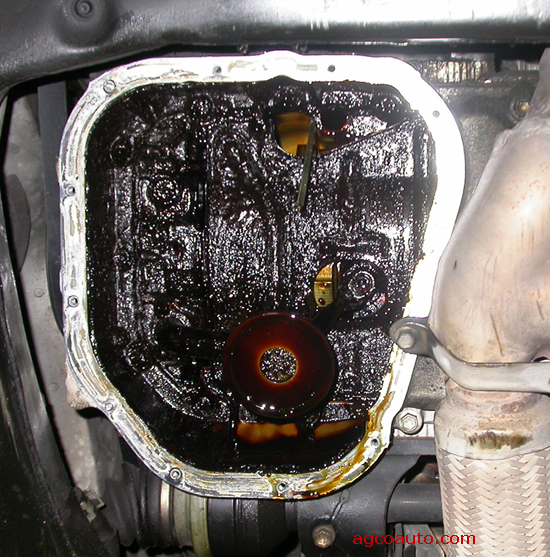
The engine below suffered a major break down after 90,000 and with 6,000-mile oil changes. The lubrication to the upper end was restricted by the sludge buildup.
Oil and noise from the timing cover were the first tip off. The timing chain stretched and was rubbing on the timing cover. This is the cover after extensive cleaning.
The problem with the test supporting extended oil changes are, they are run on vehicles that get a lot of use. Taxi cabs, police fleets and test vehicles. These vehicles often see 50,000 miles a year and are being run with the engines at full operating temperature. This is ideal conditions for engine oil. The high temperatures quickly boil contaminants that are extracted by the positive crankcase ventilation (PCV) system.
This is not the case with the average passenger vehicle. Most vehicles operate five to ten-miles at a time. They rarely reach and hold operating temperature for long periods. In such a vehicle contaminants collect in the oil. This produces sludge, acids and depletes additives designed to keep seals pliable. The effect may be drastically increased repair cost.
Like any piece of metal that is heated and allowed to cool, there will be condensation in an engine. The oil attempts to suspend these contaminants. Since the contaminants are liquid, they pass through the oil filter. When engine oil temperature reaches 212' Fahrenheit, the liquids may begin to boil. They turn to vapor and eventually are extracted through the PCV system. This does not occur with five to ten-mile trips. Many engines also have small amounts of glycol that leaks past head and intake gaskets. This severely compounds the problem.
Another major difference between test and "real world" conditions is time. These factors take time to damage the engine. Running an engine for one-year and 50,000 miles may show no problem at all. The same engine run five years and 50,000 miles may tell a completely different tale.
The sad truth is, once the problem is discovered, it may be too late to correct
It is quite common for us to see vehicles with 200,000 to 300,000 miles that are still giving excellent service. Largely these are vehicles that have been well maintained, with three thousand mile oil changes. It is also very common to see vehicles with 100,000 miles that are no longer economically feasible to repair (NEFR.) Overall lowest cost of driving dictates prevention of problems, rather than repair or replacement.
Common misconceptions about oil changes
Myth: Used oil is an environmental concern, going longer between changes keeps oil out of the environment.
Truth: Virtually all used oil from service shops is recycled. It is used to produce heating oil and other lubricants and this is closely regulated by the EPA. Oil leaks and oil consumption caused by poor maintenance is a major problem with pollutants.
Myth: Modern engines don’t breakdown oil like older engines did.
Truth: Basic engine design has changed very little in many years. The operating conditions of the vehicle largely determine the effective life of the oil.
Myth: Driving to and from work and the store is normal conditions as defined by the vehicle manufacturer.
Truth: Driving short five to ten-mile trips and stop and go driving are considered severe service by many manufacturers. This is much harder on an engine than 300-500 mile trips and requires more frequent service.
Myth: Using synthetic oil allows a vehicle to be driven much further between oil changes.
Truth:Synthetic oil is much tougher than conventional oil. Because of enhanced cleaning properties it actually gets dirty faster as well. One reason to use synthetic oil is their ability to clean the engine. Contaminants must be removed once the cleaning is done. A very good clothes detergent may clean clothes very well. This does not mean the same batch of detergent can be used over and again to clean subsequent batches.
Registered visitors are always invited to leave their comments and thoughts by using the form above. If you need to you can login here or register here.
You can also win a free AGCO coffee cup, by reporting any errors you find, with this form.




 Myth: Used oil is an environmental concern, going longer between changes keeps oil out of the environment.
 Truth: Virtually all used oil from service shops is recycled. It is used to produce heating oil and other lubricants and this is closely regulated by the EPA. Oil leaks and oil consumption caused by poor maintenance is a major problem with pollutants.