Most folks have heard of oil viscosity. Many people may know what it is, but are not certain about the details. No one intends this article as a technically complete piece on the topic. Instead, this is a light overview as the term relates to engine oil.
The Society of Automotive Engineers or SAE, provides a scale by which we classify motor oil. This is the familiar "weight" rating. For instance, the term 30 weight motor oil refers to viscosity. Simply, viscosity is a resistance to flow or sort of how thick the oil is.
A standard test method
To insure uniformity, the SAE has designed specific tests to measure the flow rate of oil. A SAE weight number refers to results of these testing procedures. A test might involve how long it takes a measured quantity of oil to drip through a fixed opening at a set temperature. The temperature used in testing motor oil is normally 100 degrees Celsius or about 212 degrees Fahrenheit. This is close to the operating temperatures in most engines.
Weight
Minimum
Maximum
(SAE)
(seconds)
(seconds)
20
5.6
9.3
30
9.3
12.5
40
12.5
16.3
An established quantity of SAE twenty-weight oil would take 5.6 to 9.3 seconds to drip through the opening. In the SAE rating system the higher the number the thicker the oil and the slower it will flow.
Thick oil provides additional protection but may not flow fast enough to provide needed lubrication. Lower viscosity oil offers less resistance to load, but reaches critical areas faster. Engineers are very precise in the oil they specify for an engine and we should always use the recommended viscosity.
Multi-viscosity oil
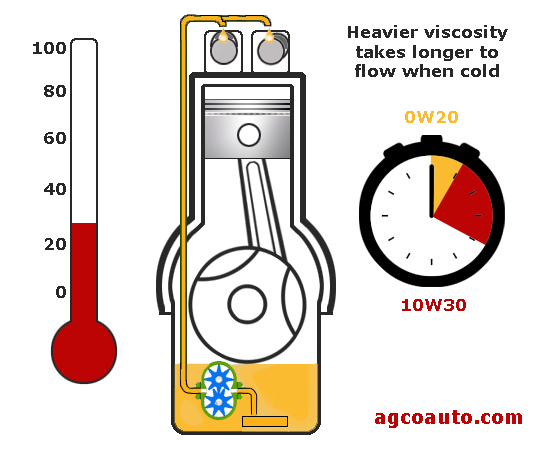
Oil is also thicker when it is cold than when it is hot. Engines operate over a wide range of temperatures. For instance an engine may start at 70 degrees Fahrenheit and warm up to 212 degrees. Oil thick enough to protect the engine at 212 degrees may be too thick to flow at 70 degrees. This deprives the engine of needed lubrication when it is cold.
Multi-viscosity oil solves this problem. By adding viscosity improver (VI) to oil the thinning out at temperature is greatly reduced. This means it stays very near the same viscosity over a wide range of temperatures. An example of an SAE multi-viscosity oil is 5W30.
The 5 means the oil can flow like a five-weight oil at low temperature. The W means winter and refers to the suitability for cold weather use. The 30 indicates the oil will still test the same as a thirty weight oil at 100 degrees Celsius. The oil specified by the manufacturer will give all of the lubrication needed, for the life of the engine.
Modern engines commonly use 5W30, 5W20 and 0W20 oil. This provides for good lubrication on startup and full protection at temperature. General Motors has established other specifications we call dexos. All GM vehicles built after 2010 require oil that they label dexos. This does not replace the viscosity requirement. Dexos specifications are separate than viscosity of the oil.
Using an oil viscosity other than specified
A popular misconception is that 10W30 oil is thicker than 5W30. At 100 degrees Celsius (operating temperature) they are the same thickness, 30 weight. The problem is on startup, 10W30 cannot flow (lubricate) as fast as 5W30. Lack of startup lubrication can drastically shorten the life of an engine. Always use the oil specified by the vehicle manufacturer.
Along with lubrication, oil also cools, cleans and protects the engine from corrosion. On engines with variable valve timing and displacement on demand, it also operates the necessary components. Many engines also use hydraulic tensioners on timing belts and chains. Using the improper viscosity can cause several problems. For instance, putting a thicker oil in an engine can increase volatility and damage an expensive catalytic converter.
Oil need not be a complicated subject. Using the oil specified by the maker of the vehicle and changing it on a regular basis will help keep your engine running for years to come.
Registered visitors are always invited to leave their comments and thoughts by using the form above. If you need to you can login here or register here.
You can also win a free AGCO coffee cup, by reporting any errors you find, with this form.



 The 5 means the oil can flow like a five-weight oil at low temperature. The W means winter and refers to the suitability for cold weather use. The 30 indicates the oil will still test the same as a thirty weight oil at 100 degrees Celsius. The oil specified by the manufacturer will give all of the lubrication needed, for the life of the engine.