Many people are confused by a timing belt. Not every engine has one, but those that do require replacement at a specific mileage or time interval. Timing belts offer a number of advantages, such as light weight and precise timing over their lives. The timing belt is also far less affected by lubrication problems than a chain or gear drive. Like any piece of rubber, a timing belt will deteriorate in time. To know if your engine has a timing belt, it is best to refer to the owner's manual or ask to a trusted professional.
How timing belts work
They design a timing belt with teeth that mesh with grooves in the crankshaft and camshaft sprockets. This arrangement allows the timing belt to keep the camshaft and crankshaft in perfect time. Engineers normally provide a tensioner which keeps the timing belt tight.
Timing belts are made of a very durable rubber, with layers of cord to prevent stretching. This arrangement provides years of trouble free service and precise valve timing. Eventually the rubber and cords begin to deteriorate. They recommend replacing the timing belt for this reason. The recommended replacement interval for a timing belt varies, depending on several factors. The design of the engine and the age of the belt determines when it should be replaced, and vehicle manufacturers provide guidelines which must be followed.
Interference and non-interference engines
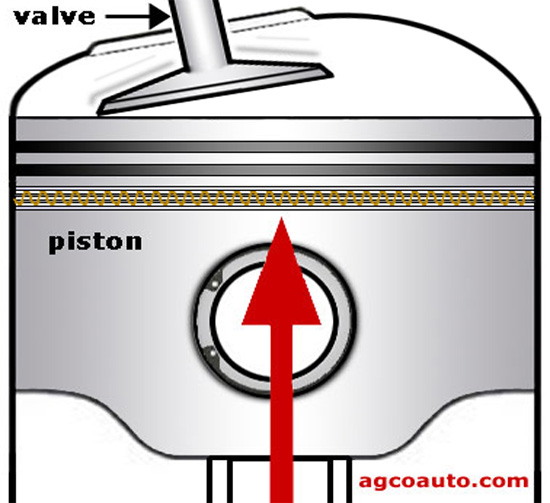
We often hear engines referred to as interference and non-interference types. An interference engine is one where the engine valves, and pistons occupy the same place, just not at the same time. On an interference engine, the valves will hit the pistons, if the timing belt breaks or slips. The result will be engine damage.
They use interference designs because they allow more horsepower. The drawback is an elevated risk of the belt breaking or slipping. Pushing such an engine beyond the recommended time or age interval is very unwise.
For a list of popular Asian and Domestic interference engines, please click here.
When they build an engine for lower performance, the valves do not extend as far into the cylinders. They call these engines non-interference type. This is a bit misleading as under the wrong conditions, any engine may suffer damage if the valve timing is off. The name, non-interference sometimes lulls people into a false sense of security.
When timing belts slip or break, at least the engine will stop running and other damage can occur. An engine listed as non-interference does NOT mean it is safe to neglect timing belt replacement. Timing belts are normally recommended between 60,000 and 105,000 miles. The interference type engines are closer to the lower end and the non-interference type closer to the higher end.
The age factor
Time is perhaps more important than miles, in the life of a timing belt. Seven years is the maximum life of the timing belt, recommended by most manufacturers.
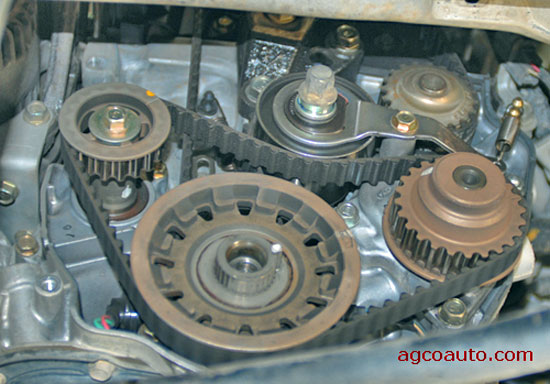
For instance, even if the engine has only 30,000 miles, but is seven years of age, the belt should be replaced. The timing belt in the photo above is eight years old, and only has 30,000 miles of use. Because timing belts deteriorate with age, time is even more critical than miles. More timing belts break due to age than mileage.
Things replaced with the timing belt
Replacing a timing belt normally involves a good deal of effort. Because of this, there are several other components in near proximity, that might also be replaced. For instance, the water pump, if under the timing cover, can be replaced at a greatly reduced price. Because water pumps wear out, many people see the wisdom of replacing it when the belt is replaced. Not replacing these components often results in an expensive re-do of the timing belt job. Doing a complete job is far less expensive and less dangerous than having to do the job over.
When pricing a timing belt replacement, we must know what we are buying. Some companies quote a price for replacing the belt alone. Quality auto repair shops refer to this as a belt slap. This may seem like a savings, until they call back with the real cost.
Perhaps worse is only replacing the belt, only to have another component fail. For instance, if the water pump fails, ten-thousand miles after the timing belt is replaced. Repair means another full disassembly and the water pump can actually cause the replaced timing belt to break.
Another problem is a seal that starts to leak after timing belt replacement. The seal could have been replaced for a minimum cost while the timing belt was off. Now many of the same components must again be removed. Worse, the oil from the leaking seal can ruin a new timing belt. Remember, you never get more than you pay for.
Upper view partially disassembled timing belt
Lower view, partially disassembled timing belt
A timing belt is not the same as a serpentine belt
Vehicles are also equipped with exterior belts and serpentine belts. Folks sometimes confuse these and think replacing the outside belts is the same as the timing belt. The timing belt is inside of the engine. If your vehicle is seven years old or older, check to see if it is equipped with a timing belt. If so, be sure the timing belt has been replaced. This can save an engine, in many cases.
Registered visitors are always invited to leave their comments and thoughts by using the form above. If you need to you can login here or register here.
You can also win a free AGCO coffee cup, by reporting any errors you find, with this form.