In 1991 Ford Motor Company introduced their first modular V-8 engine. This was for the 1991 Lincoln Town Car and the cylinder displacement was 4.6 liters. The engine is popular and is produced in a number of displacements. They also build two, three and four-valve per cylinder versions with different cylinder heads
The Ford 4.6 liter and 5.4 liter engines power millions of SUV, truck and car models. The Ford Modular engine is well engineered, but it is designed for specific lubrication. The oil viscosity and the type of oil filter can mean the difference between reliable service and an expensive repair.
Why the proper oil is so important
The modular engine is an overhead cam design. Two very long timing chains keep the camshafts in time with the crankshaft. Because of the length of the chains, guides are needed to reduce movement. They also use a hydraulic tensioner to keep each chain tight. Oil pressure moves the tensioner which controls slack in the timing chains. These components rely heavily on proper lubrication from the engine’s oil.
Ford originally specified a 5W30 motor oil for the engine. They soon found this caused oil consumption and possible catalytic converter problems. This caused a change in the specification to a 5W20 or a 5W20 synthetic blend. It is also believed the lower viscosity oil can travel to the timing chain tensioners more quickly. The oil filter they designed for the engine also has a specific anti drain-back valve and for good reason.
The anti drain-back oil filter
With a substandard oil filter the engine oil may drain back to the oil pan when the engine is turned off. A lack of oil pressure means the tensioners cannot immediately tighten the timing chains on startup. When this occurs, slack in the chain tends to jerk and the plastic timing chain guides can break.
The problem of broken guides on the timing-chain
We see many Ford modular engines with broken timing chain guides. The first symptom is usually a rattle on the start up. Because the timing chains are so long, they are supported by plastic guides. The timing chain is kept tight by force from the hydraulic tensioners. With the proper lubrication and the right oil filter this works very well for a great many miles. Problems begin when improper viscosity oil and substandard oil filters are used.
With a substandard oil filter the engine oil may drain back to the oil pan when the engine is turned off. A lack of oil pressure means tensioners cannot immediately tighten the timing chains on startup. When this occurs slack in the chain tends to jerk and the plastic timing chain guides can break.
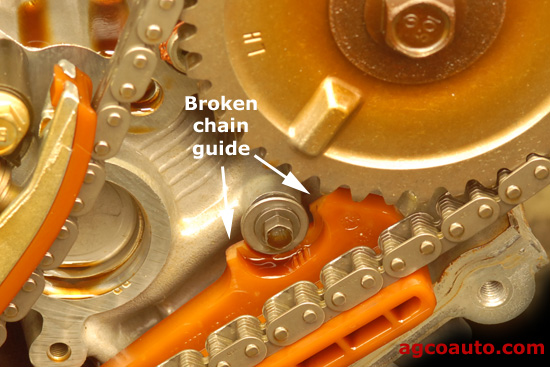
Symptoms of a broken timing chain guide can range from a rattle noise on startup (not always) to rough idle to a check engine light. This engine was fitted with the proper Motorcraft filter after the noise started. Unfortunately it was too late to prevent an expensive repair. The guide on the left bank is broken and the check engine light has come on.
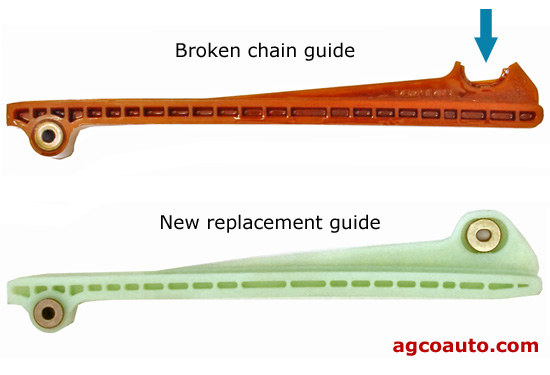
A broken chain guide is apparent, once removed and compared with a new part. The guide most often breaks where the mounting bushing passes through. This allows the chain to drop down and often it starts to rattle, until the tensioner removes the slack.
When the timing chain guide (1) breaks, the chain drops down. The chain tensioner (2) attempts to take up the excess slack in the timing chain. When the tensioner piston extends, the chain is pulled tight. Removing this slack on one side of the chain also causes the cam sprocket (3) to rotate and change camshaft timing on that bank.
Rotating one cam sprocket disturbs valve timing relative to the other side of the engine. This can cause a rough idle can set diagnostic trouble code (DTC) P0300 and codes for lean and rich operation. Many times these engines come to us, after having been mis-diagnosed elsewhere. Needless part replacement has often been a further waste of money. Repair involves timing cover removal and replacement of the chains, guides, tensioners, etc. Changing to the proper oil viscosity and a Motorcraft oil filter, prevents an expensive repeat of the problem.
Replacing the timing chains
To replace the chains and guides, we must be certain to align the camshafts and crankshaft. If valve timing is not properly set, the valves may hit the pistons and cause severe engine damage. Timing a Ford modular engine is not a simple task. Articles on the internet state, not turning the camshafts or crankshaft allows replacing the chains without timing the engine. This is very dangerous at best and may cost an engine. It also fails to recognize cam timing is already off when a guide breaks.
Ford recommends a series of special tools to hold the camshafts and crankshaft in place to install the timing chain. Many special tools are available but three will suffice, for simply replacing the chains
Rotunda-tool number 303-413 or equivalent, plugs into the hole in the end of each camshaft and provide a means of alignment. This tool has slots on each side. Tool number 303-380 engages these slots and holds the camshaft in precise alignment. The base of the holding tool rests on the top of the cylinder head. A third tool is available to hold the crankshaft in position. Rotunda-tool number 303-448 slips over the snout of the crankshaft and prevents movement. With these tools the camshafts and crankshaft are precisely positioned while we install the chains.
Buying such special tools is very expensive and some may try to get by without them. In many areas of the Country these tools are available for rental. Part stores and rental centers lend these out, for a price. An auto repair shop, closed on weekends may also be willing to rent these. Without the proper tools, paying someone qualified to replace the chains is less costly. Tearing the engine down once is difficult. Having to take it apart to re-time the engine is really bad.
Timing chain problems can be greatly decreased by a few simple steps
Registered visitors are always invited to leave their comments and thoughts by using the form above. If you need to you can login here or register here.
You can also win a free AGCO coffee cup, by reporting any errors you find, with this form.





 Use the