Poorly thought out change can also be very costly, without providing benefits. The Ford two-piece spark plug is a good example of this. For whatever reason, Ford decided to build a two-piece spark plug and install it in millions of their V8 engines. The unlucky people that own such a vehicle may be in for a very expensive lesson.
A poor idea, very expensive for customers
Many people might attempt to replace the spark plugs in their Ford three-valve V8 engine. The job seems simple enough. It would be, except for a major problem Ford has engineered into the vehicle.
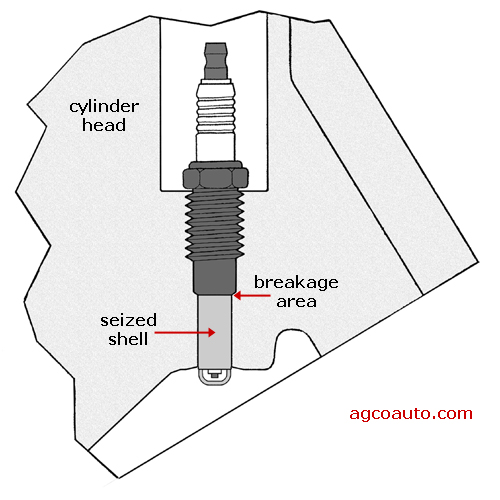
The spark plugs on the three-valve Ford V8 engines have an extension welded to the base of the normal spark plug. This fits into a tight hole and extends the spark plug tip into the combustion chamber. After several miles of use, the extension tends to seize to the aluminum cylinder head.
When we attempt to remove the spark plug, the threaded top portion comes out and the extension may remain in the cylinder head.
This is the Ford two piece spark plug
The Ford spark plug breakage problem
Piece one contains the porcelain insulator, hex base and threads. Welded to the bottom is piece two, an extension with the lower tip and electrode. While the spark plug design offers no real advantage, the lower extension often seizes in the cylinder head. Trying to remove the spark plug may result in breakage, with no warning, until it is too late.
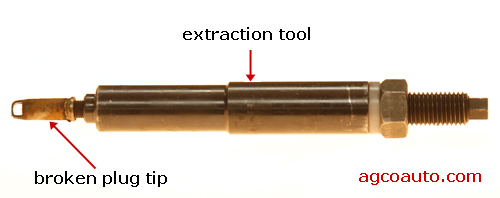
The spark plug on the left in the photo above is new. On the right is a broken spark plug, with the lower extension missing. Very often this is how the spark plugs come out of the engine. The problems are, there is no warning before it happens and it cannot be put back into place.
Before attempting to remove the spark plug, this is the way it appears in the cylinder head. Because the spark plug base is steel and the cylinder head is aluminum, corrosion often causes the extension to seize into the head.
When we attempt to remove the spark plug, the force of the threads is more than enough to separate the poorly attached extension.
Ford is very aware of the problem
Ford is well aware of the problem, but has failed to issue a recall or warranty. Instead they SELL an expensive and very time consuming set of tools to attempt to remove the broken parts. A set of pins are supplied, that are epoxied into the porcelain tip. If this holds, a special puller is used to extract the porcelain tip. This can take several attempts and several hours.
Once the porcelain is extracted, a special tap is used to thread the metal electrode tip. A small rubber plug is first placed in the tip to prevent metal shavings from falling into the cylinder. Once threaded another special puller is used to extract the metal tip.
If all goes well, you will be out a few hundred for the tools along with a weekend or more of effort. If all does not go well, removing the engine and cylinder heads might be the other option.
Ford engines that come with two-piece spark plugs
The shape of the valve covers helps to identify the three-valve engine, with the two-piece spark plugs from the two-valve engine that does not use them.
Ford 4.6L, 5.4L and 6.8L 3 Valve engines have the two piece spark plug; The 2 Valve engine does not use this plug
FORD:
2005-2008 Mustang
2004-2008 F-150
2005-2008 Expedition, F-Super Duty
2006-2008 Explorer,
F-53 Motorhome Chassis
2007-2008 Explorer Sport Trac
LINCOLN:
2005-2008 Navigator
2006-2008 Mark LT
MERCURY:
2006-2008 Mountaineer
Fortunately, Ford finally redesigned the spark plug in 2009. Vehicle models from 2009 on do not use the original design. These later model spark plugs are installed in the earlier engines and prevent the problem from recurring.
Tips to help avoid breaking Ford two-piece spark plugs
The sooner these plugs are replaced the better the chances of removal without breaking. Where possible, replace them before 50,000 miles.
The engine needs to be cool when attempting removal.
Loosen the plug no more than 1/4 turn. Stop and pour a small amount of carbon dissolving solvent into the plug tube. Motorcraft offers chemical PM3. Allow this to sit and hopefully loosen the carbon.
Tighten the plug and then loosen again, several times. Do not apply more than 35 foot-pounds of torque trying to remove the plugs.
If the plug comes out, crank the engine several times to expel any liquid that could have entered the cylinder.
These plugs often snap off with little or no warning. If you do not wish to attempt removal of the broken plug(s) tow the vehicle to a quality shop like AGCO.
Registered visitors are always invited to leave their comments and thoughts by using the form above. If you need to you can login here or register here.
You can also win a free AGCO coffee cup, by reporting any errors you find, with this form.







 The sooner these plugs are replaced the better the chances of removal without breaking. Where possible, replace them before 50,000 miles.