Properly checking the automatic transmission fluid level is not as simple as most people think. Vehicles use different procedures and even getting a correct reading can be tricky. This guide should help get accurate automatic-transmission fluid level readings.
Procedures vary from one vehicle to another
Each manufacture determines a procedure that gives an accurate reading when checking the automatic transmission fluid level in their transmission. For instance, we check most vehicles with the engine running, but we check most Honda vehicles with the engine off.
Many manufacturers have eliminated the dipstick on their transmissions and checking the fluid level requires specialized tooling and procedures. Always check the owner’s manual or service data for the proper conditions before checking the automatic transmission fluid level
Why check the automatic transmission fluid level
Automatic transmission fluid is the life blood of the transmission. The fluid produces hydraulic pressure needed to operate the transmission. It also cools and lubricates the transmission. When the fluid level is low, the pump may draw air into the system. Air in the hydraulic system interrupts the proper flow of automatic transmission fluid. Damage may occur very quickly, when transmission fluid is low.
A leak in the automatic transmission is the most common cause for low fluid. Unless we check the level, we may not know, until it is too late. Sometimes the automatic transmission may only leak while driving. This may prevent us from seeing fluid drips or spots where we park. An automatic transmission could be dangerously low and not show fluid dripping to the ground. Without checking the transmission fluid level, we may not realize the problem.
The transmission fluid color is also important
The color of the automatic transmission fluid may also give an indication of problems. Dark fluid suggests we need to check further and burned fluid shows we may have a serious problem.
Milky colored automatic transmission fluid also shows a problem. If we drive through high water, it may enter the transmission through the vent system. Failure of the radiator, in the automatic transmission cooler, allows engine coolant to enter the automatic transmission. Water dissolves the adhesive on clutch facings and causes rusting. Either of these will destroy an automatic transmission. We should always pay attention to the color of automatic transmission fluid when checking the level.
General guidelines for transmissions with a dipstick
The transmission needs to be at normal operating temperature. We should drive the vehicle at least ten minutes before attempting to check the automatic transmission fluid level.
For an accurate fluid level reading, the vehicle must be level.
To distribute the fluid, start the vehicle and slowly move the shifter to every position, including the lower gears. We check most vehicles in Park position, with the engine running and parking brake set.
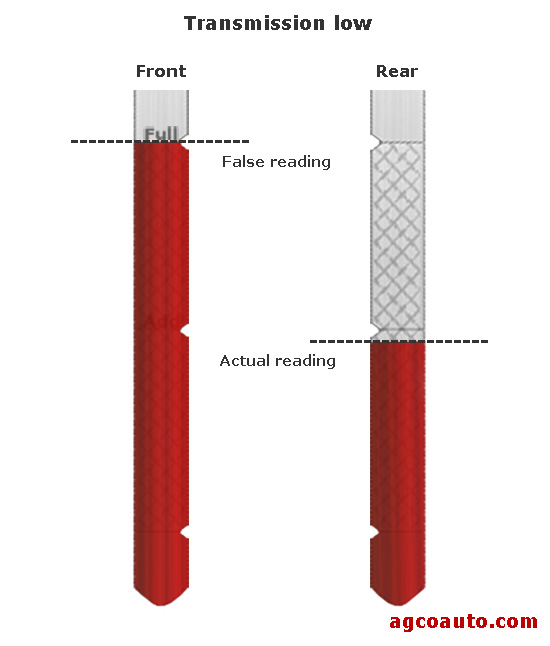
On vehicles with a dipstick, we must read both sides of the stick. The LOWEST reading is the correct fluid level.
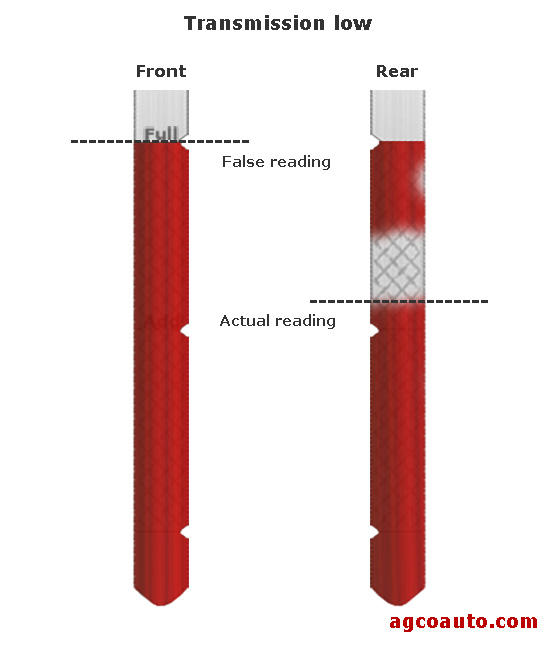
If a void or gap shows in the transmission fluid level, the LOWEST reading is the correct reading.
Check the automatic transmission fluid level at least twice, wiping the dipstick clean between readings.
With all of the above conditions met, a full transmission will show a reading like this. Both sides of the dipstick show full, with no gaps or voids in the fluid on the stick.
This is a false reading, caused by splash inside the automatic transmission. One side of the stick reads full, but the other side shows a low fluid level. The actual transmission fluid level is the low reading. We must read both sides of the transmission dipstick to get a correct fluid level reading.
A true reading will show continuous fluid with no air gaps or voids in the reading. Here the lower reading is the actual automatic transmission fluid level. The reading above the air gap is fluid from the dipstick tube and not the fluid level.
Many automatic transmissions today no longer have a dipstick
Many Fords, Toyotas, GM and imported vehicles no longer have an automatic transmission dipstick for checking the fluid level. The trend, by vehicle makers, is eliminating automatic transmission dipsticks. Newer transmissions are far more complex than older models and the transmission fluid levels are far more critical. Checking the automatic transmission fluid level in these models requires very exact procedures.
Ford products, like the Explorer 5R55(W, S and N) are a common example. These following illustrations are for Ford and may also be typical of a few others.
A closer view shows a small plug in the center of the larger plug. Removing the large plug drains the transmission. Removing the small plug checks the fluid level and can be used to fill the transmission.
This closer view shows the large hex shaped plug in the bottom of the pan. The smaller check plug in its center is removed. When the larger plug is removed, the transmission fluid drains. We fully warm the transmission to operating temperature before checking. Raising the vehicle makes access easier, but it must also be perfectly level. We remove the small plug and fluid should drip out, if the transmission fluid level is correct.
The large plug has a small internal tube to prevent fluid from coming out when the level is low. This tube is the same height as the proper fluid level, when the fluid is fully warmed. With the small plug removed and the proper fluid level, fluid will slowly drip from the opening. Too much fluid will run out in a stream. We tread a special tool into the small hole to fill the transmission. If the automatic transmission is not fully warmed before checking, it will show a false low fluid level. This is because fluid expands when heated. Adding fluid, without fully warming the transmission, will result in overfilling.
CAUTION before removing any plugs
We must be extremely careful when removing any external bolts. Some bolts look like fill plugs, but secure components within the transmission. Though they may look like a fill plug, removing them can create problems that require transmission disassembly.
Toyota automatic transmissions require an even more specialized procedure which we cover in another Detailed Topic on the subject.
Each transmission requires its own fluid type
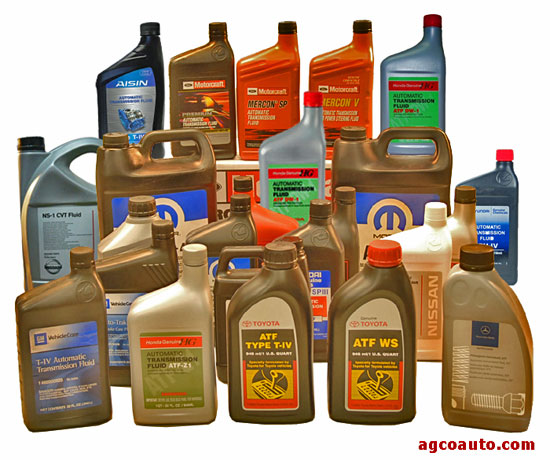
Installing only the proper fluid is as important as the checking procedure. Dozens of transmission fluids are in common use today. Using the improper fluid can cause shifting concerns, void a transmission's warranty and possibly damage the transmission.
Registered visitors are always invited to leave their comments and thoughts by using the form above. If you need to you can login here or register here.
You can also win a free AGCO coffee cup, by reporting any errors you find, with this form.