Release the steering wheel and the vehicle veers to one side. Most people think first of a wheel alignment problem. Surprisingly a tire can also cause our vehicle to pull. Tire conicity is a common phenomenon even in new tires. Many people also call it a "radial pull" and sometimes a "tire pull."
What is tire conicity?
Tire conicity is where a properly inflated tire causes a vehicle to pull to the right or left when driven. Tires do not get conicity. They manufacture them with the tendency. It is considered a defect and tire manufacturers cover tire conicity under their warranty, if we diagnose it properly and promptly.
An example of tire conicity
They install A new set of tires on a vehicle and the wheel alignment is set. It is remarkable how well the vehicle now drives. The driver can release the steering wheel and the vehicle tracks perfectly straight. The vehicle is a joy to drive.
After a few thousand miles it is time to rotate the new tires. After the tire rotation the vehicle has a hard pull to the right. The pulling gets worse as we drive faster. What happened? Did the alignment suddenly go out? We perfectly inflate the tires, but the vehicle veers hard to the right when driving. A likely cause is tire conicity, a defect in a new tire.
Diagnosis of tire conicity
After a few thousand miles you have the tires rotated. Now the vehicle has a hard pull to the right that gets worse as you drive faster. What happened; Did the alignment suddenly go out? As long as the tires are properly inflated, more likely is tire conicity, a defect in one of the new tires. Diagnosis is straight forward; temporarily cross the suspected tire to the other side and see if the vehicle pulls the other way, or stops pulling.
We need no rocket science, because diagnosis of tire conicity is straight forward. We first drive the vehicle to confirm the problem. After test driving, we temporarily cross the suspected tire to the other side of the vehicle. If the vehicle now pulls in the other direction, or stops pulling, it suggests tire conicity. The tire on the side with the pull, is the normal cause.
To confirm the issue we rotate the suspected tire back to the rear. If the vehicle again drives straight, we have found the problem tire.
Tire conicity is different from a separation
Tire conicity should not be confused with a separated, worn or damaged tire. Though each of these problems can also cause a vehicle to pull, they are each separate issues. Tire conicity or radial pull exists from the time we install the tire, because they build it into the tire when they manufactured it.
Why does conicity occur?
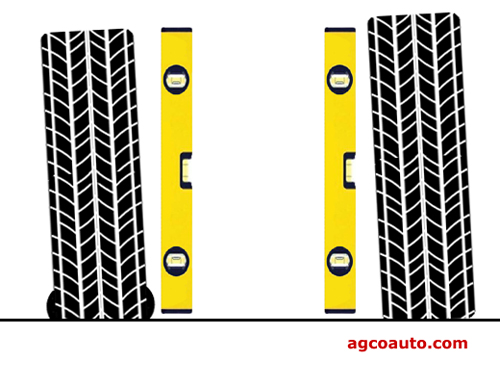
Tire conicity results when tire belts are not perfectly aligned when they build the tire. Placing the layer of belting to one side creates the problem. Because more belting is on one side than the other, the tire surface inflates improperly. The side with less belting is not as strong as the other. Inflation pushes the tread out, more on the side with less belting. The result is a tire that inflates to a cone-shape, thus the name conicity.
When we roll a cone on a flat surface, it rolls in a circle toward the point of the cone. The same thing happens with a tire. This is why the vehicle pulls when the defective tire is placed on the front. When we place the tire on the rear, the effect is much less, but can also cause a pull if bad enough. We exaggerate the above illustrations for clarity. In reality we cannot see conicity with the eye.
When we install a new tire that has conicity on the front, the effect is obvious. It may go unnoticed when we originally install the tire having conicity on the rear. A driver may only notice the problem several thousand miles later, when they rotate the tire to the front and feel the pull.
The vehicle owner needs to notify the tire dealer promptly
Drivers require prompt action in reporting this condition to the tire company. Tire makers cover conicity under the manufacturer's warranty, but quick notification is best. If we allow the tires to wear significantly, the wear may be [falsely] blamed for the pull and warranty may be much more difficult. Replacing the tire solves the problem.
We should not try to modify the wheel alignment to compensate for tire conicity. The problem is the tire, not the alignment. Changing the alignment will only result in the pull returning, when we rotate the tires.
Tire conicity or radial pull is usually different from a pull we feel with improper wheel alignment. A caster or camber related pull is normally constant, whatever the vehicle speed. This is because the misalignment does not change as the vehicle increases speed. When radial pull or tire conicity is the problem, the degree of the pull may increase with vehicle speed. It may be hardly noticeable at low speed and quite severe at 60 MPH or more.
Other things that cause a vehicle to pull
Of course improper air pressure causes a similar problem. Always verify the tire pressure, with a precision gauge, before condemning a tire. A tire with low pressure increases rolling resistance and causes a pull.
Low air pressure in one tire also causes the vehicle to lean. Wheel alignment is based on level so a leaning vehicle will be out of proper alignment. A low tire also affects camber on the opposite wheel. Incorrect camber causes a pull and tire wear.
Tire conicity is a well-known defect in a new tire. Variation in the manufacturing process causes it and not the driver or the tire store. Tire manufacturers should have no problem replacing such tires if they are promptly and properly diagnosed.
Registered visitors are always invited to leave their comments and thoughts by using the form above. If you need to you can login here or register here.
You can also win a free AGCO coffee cup, by reporting any errors you find, with this form.