Fuel filters clean fuel and help protect fuel injectors. Good maintenance has always dictated replacing fuel filters at regular intervals. Today they are disappearing from maintenance schedules and the under side of vehicles.
Many car and truck owners have replaced their own fuel filters over the years. Replacement was an easy task. Just look under the vehicle, follow the fuel lines and find the filter. With simple hand tools the average vehicle owner replaced their own filter.
Where's the fuel filter?
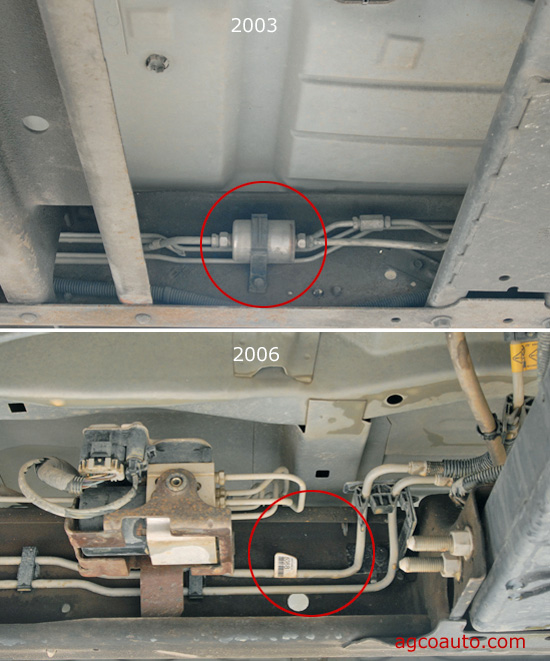
The Chevrolet Silverado, Tahoe, Suburban, Avalanche and GMC Sierra and Yukon are very popular vehicles. Until 2003 the fuel filter was easily replaceable by most enthusiasts.
Look for the fuel filter on a 2004 or newer model and there may be a surprise. These vehicles and millions of others, no longer have an external fuel filter. Instead they have moved the fuel filter inside the fuel tank. On the GM truck and SUV models mentioned the fuel filter is available only with a new fuel pump.
Fuel filters in the fuel tank
Today many manufacturers are placing the fuel filter inside the fuel tank. This cuts assembly-line time and removes possible warranty problems. Removing items from a vehicle’s maintenance schedule also makes costs seem lower. In the short-term this may be true, but not when keeping a vehicle for 100,000 miles or more.
Removing the fuel filter from the maintenance schedule appears to save the costs of replacing it. Unfortunately, filters may still become restricted in time. Placing the fuel filter in the tank may offer a savings in the short-term, but greatly increases the cost of service in the future. The fuel filter on a GM truck or SUV, is only available as part of the fuel pump module. Replacement means removing the fuel tank to replace the pump.
Fuel-tank mounted filters are nothing new. Many vehicles have used them for years.
Most in-tank fuel filters are larger than their external counterparts. In theory, they should give many years of service. For instance, Toyota, Honda and Nissan in-tank fuel filters will usually last at least 100,000 miles.
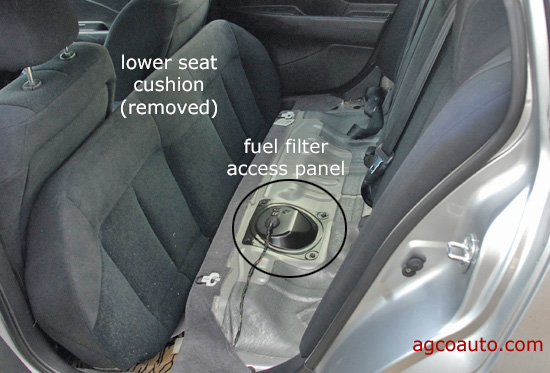
Fortunately, these vehicles have access panels and they sell the fuel filter separately. It normally requires about an hour to remove the seat, access panel, fuel-pump and replace the filter. Without this access panel, we must remove the fuel tank to replace the filter. This is the case on the GM vehicles mentioned above.
How a fuel filter works
They refine fuel to a very clean standard. Transporting, storing and dispensing it add lots of debris. This debris will damage the fuel system of our vehicles if the fuel filter does not remove it.
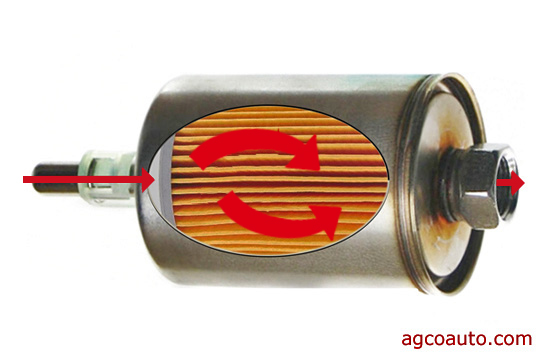
Cutting a fuel filter open reveals a simple design. A pleated material serves as the filter media. Fuel enters the housing and flows around the media. Fuel pressure pushes the fuel through the filter, trapping debris between the filter media and the housing. Clean fuel flows through and out of the filter to the injectors. If the fuel filter did not trap the inevitable debris, the fuel injectors would soon be clogged.
The debris removed collect in the pores of the filter media. As the fuel filter does its job, the element becomes restricted. Debris reduces the fuel that can flow. If the filter restricts too much fuel, the fuel pump cannot provide enough volume to the injectors. Lowered fuel volume will reduce power and may cause the engine to hesitate, misfire or stall.
Symptoms of a bad fuel filter
One typical example of a restricted fuel filter is a vehicle that cuts out or loses power driving up an incline, such as a bridge. Under load, fuel demand increases and a clogged fuel filter reduces the needed flow. As the fuel filter gets dirty, the fuel pump works much harder. This is why a restricted filter will damage the fuel pump.
A misfire at idle or a vehicle that is hard to start is NOT normally a symptom of a bad fuel filter. Fuel requirements at an idle or startup are low. Even a badly restricted filter can supply adequate fuel under low load conditions. As the need for fuel flow increases, the restricted filter will reveal itself. This is why we notice bad fuel filters on acceleration and when climbing an incline.
The fuel volume test is very handy in determining fuel filter restriction. Pressure will drop when we start the volume flow test. Restricted fuel filters may show adequate pressure with a lack of flow. Reduced fuel volume will cause the fuel pressure to fall under high demand. A technician may also check fuel pump amperage or use a digital lab scope to observe the fuel pump wave-pattern. Excess loading, from a bad fuel filter, will show on the lab scope image and may increase the amperage draw.
Check engine lights and fuel filters
Vehicle designers do not include a check-engine code for a restricted fuel filter. Though the system does not monitor the fuel filter directly, a plugged filter may cause a check engine light to illuminate. For example, decreased fuel flow may cause lean codes, such as P0171 and P0174. Other vehicles may interpret a plugged fuel filter as an oxygen sensor fault or a mass air flow problem. The computer senses fuel/air mixture that is not correct and sets a fault code, according to programming. This can be misleading and folks unfamiliar with diagnosis may replace many good parts, without realizing the actual problem.
A plugged fuel filter may also produce engine cylinder misfires. Most often, these will be random misfires, and not peculiar to a single cylinder. A code such as P0300 would be an example. Finding the cause is easier when the conditions under which the misfire sets are considered. For instance, a misfire under a heavy engine load would suggest a fuel filter problem. A fuel filter restriction is not the likely cause of an engine running rough when idling. Fuel flow is small at an idle and much heavier under an engine load. The plugged filter most often causes a problem when demand for flow is high.
Transmissions and incorrect fuel filter diagnosis
People sometimes misinterpret symptoms of a fuel filter problem as a transmission problem. Lowered fuel pressure, from a restricted filter, may cause the transmission to shift erratically or not at all. Drivers often incorrectly diagnose pressing the accelerator without the vehicle increasing speed, as a transmission issue. They have needlessly replaced transmissions because of mistakes in diagnosing the actual cause. Driving the vehicle under a load, while testing fuel pressure, will help to eliminate mistakes of this nature.
Fuel line attachments
Years ago, hose clamps attached most fuel filters to the supply lines. This is NOT SO today. Vintage fuel systems operate at around five to ten PSI of pressure. Modern fuel systems often require ten-times that pressure to run. The fittings may appear similar, but a modern snap-type fitting is NOT replaceable by a fuel clamp. If the connector is damaged, we may repair some fuel lines, using special high-pressure line equipment. Sometimes replacing the entire fuel line is necessary. Modern fuel lines cannot be repaired with a clamp on fitting.
Removing various snap-together fuel fittings require several types of special tools, depending on their style. Several varieties are in common use. Each connector type has a tool of its own. With the proper tool, we release the retainer and the fuel line comes loose from the filter. The new filter is simply snapped back with the high-pressure fitting. These fittings give very good service and rarely leak, but do require special handling and tools.
Like most things on modern vehicles, fuel filters today are different from those of the past. Being familiar with the type used on the vehicle and having the right tools makes the job easy and safe.
Many top technicians, will cut old fuel filters open as a diagnostic procedure
Dissecting the old fuel filter tells a lot about the condition of the fuel system. By examining the contaminants trapped in the filter, we can learn of impending problems. Rust and moisture suggest the need to remove the fuel tank to inspect for problems. This is particularly helpful when a fuel pump fails. Ignoring this step can result in repeated fuel system problems, damage to the new fuel pump and fuel injectors.
The quality of the fuel used has a great affect on fuel filter life. Dirty or water-contaminated fuel quickly ruins a fuel filter. Using clean, high quality gasoline will greatly extend the life. They recommend most in-line fuel filters for replacement around 45,000 to 60,000 miles. Most in-tank fuel filters will last 100,000 miles or more. Replacing the fuel filter helps remove contaminants and reduce restriction to fuel flow. This will extend the life of the fuel system.
Registered visitors are always invited to leave their comments and thoughts by using the form above. If you need to you can login here or register here.
You can also win a free AGCO coffee cup, by reporting any errors you find, with this form.